Verbs which describe a permanent state are stative verbs. They do not normally have continuous forms.
These are:
1) verbs of the senses: see, hear, smell, feel, taste, etc.
Can you see that tall boy over there?
I can’t hear you. Can you speak louder, please? [1, p.6]
However, the verbs “feel” and “hurt” can be used in either continuous or simple forms.
How are you feeling today? / How do you feel today?
My leg is hurting. / My leg hurts. [1, p.6]
2) verbs of opinion: agree, believe, consider, etc.
I believe he’s telling the truth. [1, p.6]
3) verbs of emotion: feel, forgive, hate, like, love, etc.
Harry likes rock music. [1, p.6]
4) other verbs: appear (= seem), be, belong, fit (= be the right shape and size for something), have (= possess), know, look (= appear), need, prefer, require, want, weigh, wish, etc.
He knows where Peter is. [1, p.6]
Some stative verbs (see, smell, taste, feel , think, have, etc.) have continuous forms, but there is a difference in meaning.
| State | Action |
| I think she’s rich. (= I believe) | I’m thinking about your offer. (=I’m considering) |
| The milk tastes awful. (= has a flavour) | He is tasting the sauce; it might need some salt. (= he’s trying its flavour) |
| He has a pet dog. (= he owns) | He is having problems at work at the moment. (= experiencing) |
| This cloth feels like velvet. (= has the texture) | She is feeling her way in the dark. (= she’s finding her way) |
| I see you’re in trouble. (= I understand) | I am seeing my lawyer tonight. (= I’m visiting) |
| The kitchen smells of burnt meat. (= has the scent on) | Why are you smelling the food? (= inhaling the odour of) |
| Your hair looks great. (= it appears) | She is looking at some old photographs. (= she’s examining) |
| The baby weighs 5 kilos. (= it is) | I am weighing myself on my new scales. (= I’m finding out my weight) |
| Ann is very tall. (= has the quality) | Ann is being very kind to me these days. (= she’s behaving) |
| Source: [1, p.7] |
|
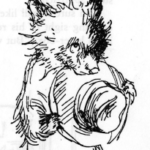
“It sounds very complicated,” said Paddington. “Can’t I just sit in a puddle or something?” [2, p.26]
“I found him up by Luckton road. He’s very cold and I thought you might be able to help him.” [3, p.123]
Sources:
- Evans, V. and Doodley, J. (2011). New Round-Up 5. Pearson Education Limited.
- Bond, M. (1992). A Bear Called Paddington. HarperCollinsPublishers.
- Story Teller Part 5. (1983). Marshall Cavendish Limited, pp.122-126.