Comparatives

Comparatives are used when we compare two things or two people.

One-syllable adjectives.

For adjectives with one syllable,  add –ER to the adjective.

Small – smaller
Tall – taller
Long – longer 
If a one-syllable adjective ends with a single consonant with a vowel before it, double the consonant and add –ER.
Big – bigger
Fat – fatter
Thin – thinner

Two-syllable adjectives

If a two-syllable adjective ends with –y, change Y to I and add –ER to the adjective. 
Happy – happier
Angry – angrier
Busy – busier
With most two-syllable adjectives, add MORE or LESS to the adjective. 
Peaceful – more peaceful / less peaceful
Pleasant – more pleasant / less pleasant
Thoughtful – more thoughtful / less thoughtful

Adjectives with three or more syllables

For adjectives with three syllables or more, add  MORE or LESS to the adjective.

Beautiful – more beautiful / less beautiful
Wonderful – more wonderful / less wonderful
Generous – more generous / less generous

Exceptions

 
Source: [1]
Two-syllable adjectives that follow two rules. 

These adjectives can be used with –ER and MORE / LESS.

Clever – clever and more / less clever

Gentle – gentler and more / less gentle

Friendly – friendlier and more / less friendly

Simple – simpler and more / less simple [2]

Noun (subject) + verb + comparative adjective + than + noun (object).

E.g. He is taller than his friend.
This flower is more beautiful than that one.

 Examples of comparatives

Timbertwig rushed out of doors and climbed up on to the roof of the house. He always went there when he was sad, and he had never been sadder than today.” [3, p.192]

“Then she noticed Timbertwig’s hat. “Oh where did you get that? It’s scruffier than the last one! What’s inside it?” [3, p. 196]

“As he grew older, the boy’s face turned a deep golden colour, brighter than the shine of his little golden bow. And when he sat on the beach, gazing out to sea, the weather was always calm and there were strange bright lights on the water.” [4, p.82]

“Paddington did look much cleaner than when he had first arrived at the Browns. His fur, which was really quite light in colour and not dark brown as it had been, was standing out like a new brush, except that it was soft and silky. His nose gleamed and his ears had lost all traces of the jam and cream. He was so much cleaner that when he arrived downstairs and entered the dining-room some time later, everyone pretended not to recognise him.” [5, p.34-35]

Song: Life is getting more and more complicated. [6]

Sources:

  1. Languagelearningbase.com. (2018). Irregular Adjectives in Comparatives and Superlatives – learn English,grammar,adjectives,english. [online] Available at: http://languagelearningbase.com/86198/irregular-adjectives-in-comparatives-and-superlatives [Accessed 7 Oct. 2018].
  2. EFLnet. (2018). Forming Comparative and Superlative Adjectives. [online] Available at: http://www.eflnet.com/tutorials/adjcompsup.php [Accessed 8 Oct. 2018].
  3. Story Teller Part 7. (1983). Marshall Cavendish Limited, pp.192-196.
  4. Story Teller Part 3. (1983). Marshall Cavendish Limited, pp.81-85.
  5. Bond, M. (1992). A Bear Called Paddington. HarperCollinsPublishers.
  6. Graham, C. (1993). Grammarchants. More Jazz Chants. Oxford University Press, p.69.

Order of Adjectives

Adjectives describe nouns and pronouns.  If there are some adjectives which describe one noun, they go in a special order. 

number, opinion, size, shape, condition, age, color, pattern, origin, material, purpose

Source: [3]
Opinion adjectives (wonderful, lovely, etc.) go before fact adjectives (big, leather, etc.).

“She lives in a lovely big flat. She bought a beautiful leather bag.” [1, p.143] (opinion, size)

That’s a wonderful large rectangular black Chinese wooden linen chest. (opinion, size, shape, color, origin, material, purpose) [1, p.143] 


“The gypsy camp was in the field just off the main road, full of shabby cars and lorries. But one painted wooden caravan stood out like a bright flower.” [2, p.123] (number, pattern, material)


Sources:

  1. Evans, V. and Doodley, J. (2011). New Round-Up 5. Pearson Education Limited.
  2. Story Teller Part 5. (1983). Marshall Cavendish Limited, pp.122-126.
  3. University of California, Irvine (2018). Adjectives and adjective clauses.Available at: https://www.coursera.org/learn/adjective-clauses/lecture/Wp2xl/adjective-order-lecture [Accessed 1 Sep. 2018].


Commas With Adjective Clauses

If a relative clause (an adjective clause) gives necessary information which is essential to the meaning, it is called a defining relative clause. The clause in not put in commas.

He is the actor who won an Oscar[1, p.104]

A non-defining relative clause gives extra information and is not essential to the meaning of the main sentence. The relative clause is put in commas.

Tim, who doesn’t like to study, failed his test again.

London, which is the capital of England, attracts many foreign visitors. [1, p.104]

“It was the first time he had ever had breakfast in bed. First of all he had trouble with the grapefruit. Every time he pressed it with his spoon a long stream of juice shot up and hit him in the eye, which was very painful.” [2, p.38]

“When he looked round everything seemed very confused. A number of people were gathered round the fat man, who was sitting on the floor rubbing his head.” [2, p.46]

Sources:

  1. Evans, V. and Doodley, J. (2011). New Round-Up 5. Pearson Education Limited.
  2. Bond, M. (1992). A Bear Called Paddington. HarperCollinsPublishers.

Adjective Clauses With “Where”, “When”

“When” is used for time relative clauses.

(When is used with the words “the year”, “the day”, “the time”, “the month”, etc.)

January 11th is the day when my daughters were born.

Grandpa remembers the old days when there was no television. [1]


“Where” is used for relative clauses describing places.

The store where I shop for food is around the corner.

The store where the new phone was being sold had a huge line of people outside it. [1]


Sources:

  1. YourDictionary. (2018). Examples of Adjective Clauses. [online] Available at: http://examples.yourdictionary.com/example-adjective-clauses.html [Accessed 1 Oct. 2018].

Adjective Clauses With Prepositions

Prepositions are normally used after the relative pronouns (using them before relative pronouns is rather formal).

Source: [1]
The man to whom I spoke is my uncle (RU-5) (formal).

The man who / that/- I spoke to is my uncle (less formal).

New York is a city to which I have traveled many times (formal).

New York is a city which I have traveled to many times (less formal).

The bus for which we were waiting was late (formal).

The bus that/which/- we were waiting for was late (less formal).

Source: [2]
Sources: 

  1. University of California, Irvine (2018). Adjectives and Adjective Clauses.Available at: https://www.coursera.org/learn/adjective-clauses/lecture/NZqfW/adjective-clauses-with-prepositions [Accessed 2 Oct. 2018].
  2. Bbc.co.uk. (2018). Learning English | BBC World Service. [online] Available at: http://www.bbc.co.uk/worldservice/learningenglish/grammar/learnit/learnitv286.shtml [Accessed 1 Oct. 2018].

Adjective Clauses With Object Pronouns

For people in adjective clauses there are four options: who, whom, that or nothing. Of these four options, whom is the most formal and is more commonly used in academic and professional writing.

For things there are only three options: which, that or nothing.

The example “Andy is a mechanic who you can trustcan be separated into two sentences: Andy is a mechanic. You can trust a mechanic. “A mechanic” is an object in the sentences. To combine two sentences, “a mechanic” in the adjective clause should be changed to who or that.

Who, that, which can be omitted in adjective clauses with object pronouns.

The movie which/that/- we watched yesterday was terrible.

The store manager whom/who/that/- they asked was rude to them.

“Paddington started. He put the suitcase guiltily behind himself and sniffed. He had several expressions which he kept for emergencies.  There was his thoughtful expression, when he stared into space and rested his chin on a paw.” [1, p.41]

“He examined carefully the piece of green cardboard which he held in his paw. “It doesn’t seem much to get for tenpence,” he said. After all the lovely whirling and clanking noises the ticket machine had made, it did seem disappointing. He’d expected much more for his money.” [1, p.42]


Sources:

  1. Bond, M. (1992). A Bear Called Paddington. HarperCollinsPublishers.

Adjective Clauses With Subject Pronouns

Adjective clauses are clauses that describe a noun. They are used to talk about nouns. There must be a subject and a verb in an adjective clause.

In the following examples in the picture the subject is a subject pronoun (=who). The verb in the adjective clause must agree with the noun it modifies. [1]

Who / that  are subject pronouns which are used for people.

There is the boy who / that started the fight.

Which / that are subject pronouns which are used for things and animals.

I saw a film which / that was very good

(There are two separate sentences here: I saw a film. The film was very good. To combine two sentences, “the film” in the adjective clause should be changed to which/that).

Subject pronouns who, that, which cannot be omitted in adjective clauses with subject pronouns.

“Paddington looked up, an expression of bliss on his face; that part of his face which could be seen behind eggy whiskers and toast crumbs.  He tried to say something, but all he could manage was a muffled grunting noise which sounded like IMJUSTCOMING all rolled into one.” [2, p.39]

“Then there was his innocent face expression which wasn’t really an expression at all. He decided to use this one.” [2, p.41]

“Paddington turned and tried to run up the escalator, but it was going very fast, and with his short legs it was as much as he could do even to stand still. He had his head down and he didn’t notice a fat man with a briefcase who was running in the opposite direction until it was too late.” [2, p.45]
 

Sources:

  1. University of California, Irvine (2018). Adjective Clauses with Subject Pronouns. Available at: https://www.coursera.org/learn/adjective-clauses/lecture/c8Qy8/adjective-clauses-with-subject-pronouns-lecture [Accessed 1 Sep. 2018].
  2. Bond, M. (1992). A Bear Called Paddington. HarperCollinsPublishers.

Past Perfect Progressive

This tense is also called the Past Perfect Continuous and is formed as:

had + been + V-ing. (V=Verb)

I/we/they/you/he/she/it had been V-ing (=I’d, we’d, they’d, you’d, he’d, she’d, it’d been V-ing)

Questions are formed as:

Had + subject+ been + V-ing ?

Short answers are formed as:

Yes, he/she/it/we/you/they had. No, he/she/it/we/you/they hadn’t.

The Past Perfect Progressive is the past equivalent of the Present Perfect Progressive and is used for:

1) a past action of certain duration which had visible results in the past.

They were wet because they had been walking in the rain. [1, p.13]

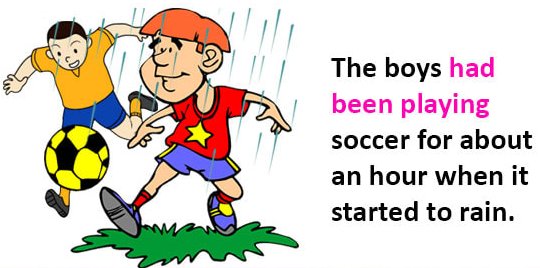
2) emphasis on the duration of an action which started and finished in the past before another past action or a stated time in the past.

She had been working as a clerk for 10 years before she resigned. [1, p.13]

3) actions started in the past and continuing up to a certain event in the past.

Source: [2]


Sources:

  1. Evans, V. and Doodley, J. (2011). New Round-Up 5. Pearson Education Limited.
  2. LET’S LEARN!. (2018). Past Perfect Continuous. [online] Available at: https://letslearnenglisheasy.weebly.com/past-perfect-continuous.html [Accessed 8 Oct. 2018].

Past Perfect

This tense is formed as:

had + past participle.

Past participle is a verb which ends in -ed (closed, opened, etc.) or an irregular verb in the 3rd form (done, written, etc.).

I/we/they/you/he/she/it had (=I’d, we’d, they’d, you’d)

Questions are formed as:

Had + subject+ past participle ?

Short answers are formed as:

Yes, he/she/it/we/you/they had. No, he/she/it/we/you/they hadn’t.

The Past Perfect is similar to the Present Perfect and is used for:

1) a past action which occurred before a specific time in the past.

He had left by the time I got there. [1, p.13]

“Before he left South Africa on his long journey to England, his Aunt Lucy, who was a very wise old bear, had done her best to teach him all she knew. She had told him all about the places he would see on the way and she had spent many long hours reading to him about the people he would meet.” [2, p.30]
2) a complete past action with a visible result in the past.

She was sad because she had failed the test. [1, p.13]

“Late one evening Drummerboy was on his way to a new home. Tom and Madge Summers had just bought him for their riding stables at Applegate.” [3, p.122]


Sources:

  1. Evans, V. and Doodley, J. (2011). New Round-Up 5. Pearson Education Limited.
  2. Bond, M. (1992). A Bear Called Paddington. HarperCollinsPublishers.
  3. Story Teller Part 5. (1983). Marshall Cavendish Limited, pp.122-126.

Present Perfect Progressive

This tense is also called the Present Perfect Continuous and is formed as:

have/has + been + V-ing. (V=Verb)

I/we/they/you have (=I’ve, we’ve, they’ve, you’ve)

He/she/it has (=he’s, she’s, it’s)

Questions are formed as:

Have/has + subject+ been + V-ing ?

Short answers are formed as:

Yes, he/she/it has. No, he/she/it hasn’t.

Yes, we/you/they have. No, we/you/they haven’t.


The Present Perfect Progressive is used for:

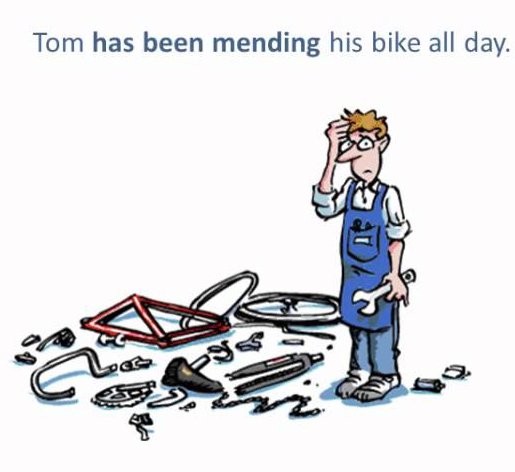
1) actions started in the past and continuing up to the present.

He has been writing a letter for two hours. [1, p.3]

Source: [2]


Song: I am sitting all alone (by anonymous) [3]

2) past actions of certain duration having visible results in the present.

Her eyes are red. She has been crying. [1, p.3]

3) emphasis on duration (usually with for, since or how long)

They have been speaking in his office for the last hour. [1, p.3]


Sources:

  1. Evans, V. and Doodley, J. (2011). New Round-Up 5. Pearson Education Limited.
  2. YouTube. (2018). Present Perfect Simple vs Present Perfect Continuous. [online] Available at: https://www.youtube.com/watch?v=-Se1seG2yo4 [Accessed 8 Oct. 2018].
  3. Веселова, Т., Вильберг, Т. and Мишина, Т. (2006). English Song . Sing and Study. КАРО, p.59.