The Present Perfect is formed as:
have/has + past participle
Past participle is a verb which ends in -ed (closed, opened, etc.) or an irregular verb in the 3rd form (done, written, etc.).
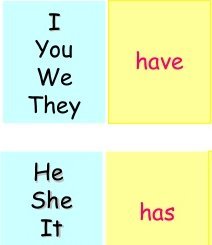
(=I’ve, we’ve, they’ve, you’ve)
(=he’s, she’s, it’s)
Questions are formed as:
have/has + subject+ past participle
“Has it stopped raining yet?” [1, p.14]
Short answers are formed as:
Yes, he/she/it has. No, he/she/it hasn’t.
Yes, we/you/they have. No, we/you/they haven’t.
Song: Have you heard the news? [7]
The Present Perfect is used for:
1) actions recently completed or which happened at an unstated time in the past with evidence or a result in the present. It means that the action in the past has a result now.
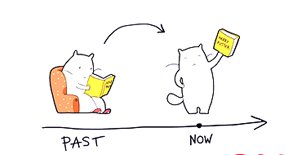
“I have read the book!” [2]
“Is Sally here?” “No, she has gone out” (= she is out now). [1, p.14]
“He has lost his keys. He is still looking for them” [3, p.3]
2) personal experience which has happened over a period of time.
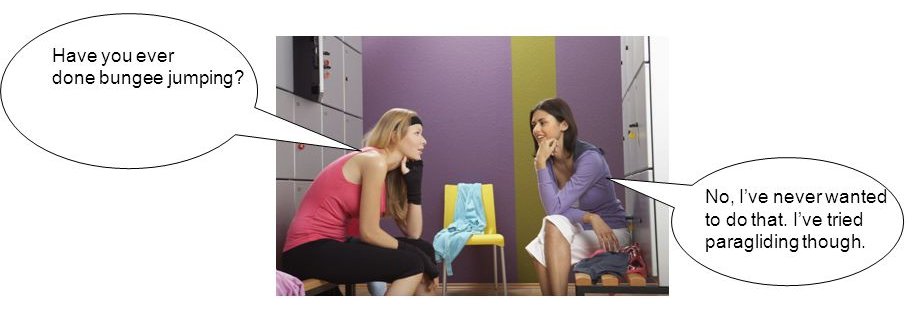
“Mrs.Bird thought for a moment. “No. No, I don’t mind at all. I’ve always had a soft spot for bears myself. It’ll be nice to have one about the house.” [4, p. 28]
3) emphasis on number.

“I have read this book three times” [5]
“She has written three letters since the morning” [3, p.3]
The Present Perfect is often used with the words just, ever, never, already, yet, so far, recently, since, for, etc.
just (=a short time ago)
“Where is Tom?” “He has just gone out”.
“Are you hungry?” “No, I’ve just had lunch.” [1, p.14]
already (= something happened sooner than expected)
“What time is Mark leaving?” “He has already left.” [1, p.14]
yet (= until now; yet is used in questions and negative sentences)
“I’ve written the email, but I haven’t sent it yet.” [1, p.14]
never
“I have never had a car” [1, p.16]
ever
“Have you ever eaten caviar?” [1, p.16]
Song: We are the champions! (QUEEN)
Time after time
I’ve done my sentence
But committed no crime
And bad mistakes
I’ve made a few
I’ve had my share of sand kicked in my face
But I’ve come through
And we’ll keep on fighting ’til the end
We are the champions
We are the champions
No time for losers
‘Cause we are the champions of the world
And my curtain calls
You brought me fame and fortune and everything that goes with it
I thank you all
No pleasure cruise
I consider it a challenge before the whole human race
And I ain’t gonna lose
And we’ll keep on fighting ’til the end
We are the champions
We are the champions
No time for losers
‘Cause we are the champions of the world
And we’ll keep on fighting ’til the end
We are the champions
We are the champions
No time for losers
‘Cause we are the champions [8]
Sources:
- Murphy, R. (2012). English Grammar in Use. 4th ed. Cambridge University Press, 380p.
- Ok-english.ru. (2018). Present Perfect в английском (теория + сборник видео уроков для разных уровней сложности). [online] Available at: http://ok-english.ru/present-perfect-2/ [Accessed 8 Oct. 2018].
- Evans, V. and Doodley, J. (2011). New Round-Up 5. Pearson Education Limited.
- Bond, M. (1992). A Bear Called Paddington. HarperCollinsPublishers.
- Pediaa.Com. (2018). Difference Between Simple Past and Present Perfect. [online] Available at: http://pediaa.com/difference-between-simple-past-and-present-perfect/ [Accessed 8 Oct. 2018].
- Slideplayer.com. (2018). Past tenses Grammar from Oxford – ppt video online download. [online] Available at: https://slideplayer.com/slide/2898466/ [Accessed 8 Oct. 2018].
- Graham, C. (1993). Grammarchants. More Jazz Chants. Oxford University Press, p.76.
- YouTube. (2018). Robbie Williams – We are the champions. [online] Available at: https://www.youtube.com/watch?v=sTeY7OQdupw [Accessed 10 Oct. 2018].