This tense is also called the Present Perfect Continuous and is formed as:
have/has + been + V-ing. (V=Verb)
I/we/they/you have (=I’ve, we’ve, they’ve, you’ve)
He/she/it has (=he’s, she’s, it’s)
Questions are formed as:
Have/has + subject+ been + V-ing ?
Short answers are formed as:
Yes, he/she/it has. No, he/she/it hasn’t.
Yes, we/you/they have. No, we/you/they haven’t.
The Present Perfect Progressive is used for:
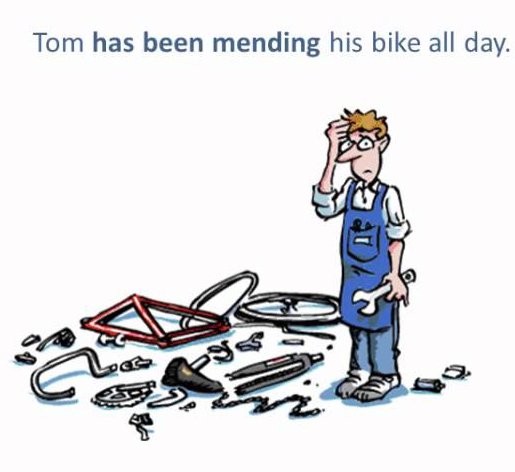
1) actions started in the past and continuing up to the present.
He has been writing a letter for two hours. [1, p.3]
Song: I am sitting all alone (by anonymous) [3]
2) past actions of certain duration having visible results in the present.
Her eyes are red. She has been crying. [1, p.3]
3) emphasis on duration (usually with for, since or how long)
They have been speaking in his office for the last hour. [1, p.3]
Sources:
- Evans, V. and Doodley, J. (2011). New Round-Up 5. Pearson Education Limited.
- YouTube. (2018). Present Perfect Simple vs Present Perfect Continuous. [online] Available at: https://www.youtube.com/watch?v=-Se1seG2yo4 [Accessed 8 Oct. 2018].
- Веселова, Т., Вильберг, Т. and Мишина, Т. (2006). English Song . Sing and Study. КАРО, p.59.